Wednesday, October 16, 2013

What is the future of money? Money developed for multiple needs. The dominant explanation is that money developed for trading when bartering wasn't sufficient. But another big boost was so that governments could more easily collect taxes. As governments grew so too did financial companies. Their symbiotic arrangement is clear around the world. With the current model of money as controlled by governments, money has become a global market as trade spread. Modern money is a high speed commodity in a global financial marketplace. Money spans the centralized markets of individual countries to form a network of international markets. What's next? Will money switch to a distributed model if money becomes electronic? Imagine a world where bitcoins are the preferred currency for purchasing. How will governments tax? Will national tax laws survive in a world where the money isn't controlled by a nation? Will national debts be supported if nobody wants national currencis?

Tuesday, September 24, 2013

Evolution of societal organizations

How does a society organize?

A societal grouping may be disorganized. Such random groupings arise as crowds in busy areas. A crowd behaves like a "gas" composed of individual that react to events. Some emergent patterns can develop from the autonomous behavior of each individual.

Structured organizations are:

    family -- the start of kin organizations pre-date history
    hierarchical -- developed 1000s of years ago and used in religions, military, and government
    corporate -- developed 100s of years ago and used for businesses
    market -- developed 100s of years ago and used for consumers
    network -- developing now?

Family structure may have been one reason why humans evolved big brains. The evolutionary advantages are large for knowing and remembering the many inter-personal relationships of a village. Instead of treating other members the same, if a person knows the other person, then both might benefit more than would occur in anonymous interactions.

The transition from "family" to "hierarchical" is thought to be due to the need to organize large militaries.

A "market" is very useful for price discovery and dealing with large numbers of buyers and sellers.

Is the internet producing a new societal organization, the "network"? People build networks of relationships that transcend other organizations. Could this be the result of an electronic society?

Friday, September 20, 2013

International reply coupons

Most investors have heard about "Ponzi schemes". These are the name for investment scams where promises are made and new investors' money is used to pay old investors. Eventually, the scheme collapses when new money slows. Surprisingly, the basis for Ponzi's scheme still exists. Ponzi bought IRCs (international reply coupons) in low-cost countries and sold them in high-cost countries. It's a valid arbitrage. IRCs can be exchanged at post offices for international postage. http://www.upu.int/en/activities/international-reply-coupons/about-irc.html Unfortunately for Ponzi's victims, while buying and selling IRCs could theoretically be profitable, there were several problems. First, the market for IRCs is small. After all, making only a few cents per IRC requires many millions to be traded before a large firm gets profitable. Second, in addition to the overhead of buying and selling coupons there is a large cost to shipping and handling all those coupons. Finally, the biggest problem was that Ponzi was an outright crook. He wasn't really buying the IRCs, he only took in investor's money and claimed he was trading IRCs.

Wednesday, September 4, 2013

Comparing advertising and economics is revealing. Both attempt to understand how people make economic decisions. From their origins over a century ago, they assumed people make rational decisions based on information. Early advertisements were loaded with information about the product. However, advertisers found that people aren't completely rational and other things besides information motivates purchases. For example, soft drinks are sold on emotion, not nutrition. Economists simplify consumers as rational consumers that seek to optimize decisions on utility. However, economists are moving beyond that simplistic view based on insights from studies of behavioral economics.

Sunday, August 11, 2013

What caused the US housing crisis? The likely answer is: many factors contributed. In the US, the federal government backs the majority of home mortgages. So its effect is large. Another factor is the Federal Reserve's actions on interest rates. Another factor was the rise in oil prices. And other factors like demographics, job trends, and foreign trade were partial causes.

The direct effect of Fannie Mac and Freddie Mac was large in expanding then collapsing the sub-prime market. This graph from the NYTimes shows how their accounting scandals in mid-2000s greatly diminished mortgage backing.
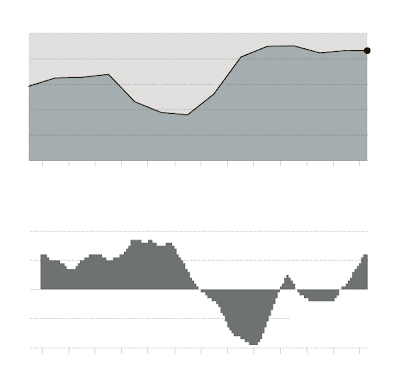
Fannie and Freddie both had multi-billion-dollar accounting scandals. Franklin Raines was CEO of Fannie Mae from 1998 to his ouster in 2004. The Clinton-appointee later paid a fine of nearly $25million. When Fannie and Freddie slowed backing mortgages, the sub-prime sector rapidly deteriorated because buyers could not get loans to purchase homes that previous sub-prime buyers now wanted to sell. The pyramid quickly crumbled.

Tuesday, July 23, 2013

I'm still confused about oil prices. Why has it jumped up in the past month? In oil commodity trader lingo, oil is in a massive backwardation. The near month contract is priced about $108/bbl but the July 2014 contract is $95/bbl. Normally, commodity markets are in "contango" where current prices are lower than next year's prices. Contango happens because the commodity has to be stored, plus there's always the unknowns that increase prices next year. Oil should have contango because its storage costs are higher than, say, metals or grains. But ... oil is acting very strange. The current spread between now and July2014 is $13, a record. (Although it's not a record if viewed as a percentage) My guess is that the traders had models of the oil inventory at Cushing, OK. But the recent reversal of a pipeline is sending crude to the Gulf but the Keystone-XL pipeline might never deliver oil to Cushing tanks. After 3 weeks of draw downs at Cushing is triggering the traders models to expect higher oil prices. My conclusion -- oil prices are at/near a high peak and are heading lower by fall.

Monday, June 17, 2013

Economics of beer

Beer is shaped by political and economic forces. Historically, what has been a typical beer varies across societies. At its basic level, beer is fermented grain. But on a practical level, how a beer is made is subject to many variables. While some styles of beers depend on technology like modern light lagers depends on carefully controlled malting and powerful chilling, other styles were developed or influenced from tax laws or government policies.

For example, the Belgian Wit beer was created partly from how its production was taxed. Taxes were calculated from the amount of malted grain so thrifty brewers used some un-malted grain to save money.

Many countries tax beer by alcohol level. Germany has tax brackets that define beer. Einfachbiers (translated "simple beers") have an alcohol level of about 1%. Similarly, schankbiers have an alcohol level of 0.5 - 2.6%. Very few beers fall into this category. Many more beers are vollbiers (translated "full beers") with between 3 and 5.3% alcohol. Finally, starkbiers (translated "strong beers") have alcohol level over 5%.

A common myth is that IPAs (Indian Pale Ales) were made hoppier and more alcoholic to survive a long sea voyage. That explanation is unlikely to be the reason. Instead, IPAs were likely based on a style of beers, called October beers, that were brewed for aging. Other styles of beer, some much lighter, were also exported to India. What seems to be the reason that IPAs became established was that England taxed exported beers differently than domestic beers. Beers were taxed by their quantity of grain, except if the beer was exported. At the beginning all beers were of similar strength but exported beers remained at that level while domestic beers gradually weakened as taxes rose.